 In the article “Men and Women’s Studies: Promises, Pitfalls, and Possibilities,” Michael Kimmel outlines the importance of women’s studies not only to women but also men. He states, “I want to take the position that women’s studies is also about men. Or, rather that it makes masculinity potentially visible as a specific construction, and not simply the unexamined norm” (Bordo et al 471). Rather than examining women’s studies as strictly female-focused, only benefiting women, Kimmel illuminates the impact these studies have on illuminating men to their often unacknowledged masculinity. Rather than depicting women’s studies as strictly beneficial to women’s liberation, Kimmel believes “by making women visible, women’s studies also made men visible both to women and to themselves” (471). This truly remarkable statement helped me to feel more at home in the ideas of women’s studies and gender studies as a whole because it calls on the socially constructed nature of gender and its performative expectations of power and control. Yes, women’s studies are incredibly impactful to the Women’s Liberation Movement, but it is also invaluable for its ability to call no men to question the constructs of gender and the consequences of such.
With this understanding of the potentially unifying power of women’s studies, Kimmel continues to illuminate the concept of gender to the reader via the power dynamics. Through women’s studies, people are able to see their position in the world clearer. We can begin to question the inherited notions of the male/female power dynamic by “making women visible” (472). Kimmel emphasizes the power of women’s studies to “(decenter) men as the unexamined, disembodied authorial voice . . . and (show) that men, as well as women, are utterly embodied, their identities as socially constructed as those of women” (472). No longer exiled to the periphery, women are able to question their own power in a male-dominated world that often leaves the men in a position of authority. These challenges not only allow for further agency development of women but also illuminate men to the social constructs surrounding their identities. Once this seed of understanding is planted in the minds of men and women, the deconstruction of social hierarchy and power dynamics can begin to bridge the gaps that divide the notions of masculinity and femininity.

 John Stoltenberg discusses the false sense of gender and power in his article “How Men Have (A) Sex: An Address to College Students.” I loved this article for how it begins—calling on students to imagine a world of limitless sexualities and possibilities. A world in which there are no strict categories of classification because everyone is different. It is in accepting these differences that the creatures on this planet “are capable of having a sense of personal identity without struggling to fit into a group identity based on how they were born” (480). This freedom allows the creatures to live happy lives because “they don’t worry about sorting other creatures into categories, so they don’t have to worry about whether they are measuring up to some category they themselves are supposed to belong to” (480). By eliminating the category system, a system that pervades our contemporary world, the very notion of sexes is no longer necessary “so sex between creatures is free to be between genuine individuals—not representatives of a category” (480). As the article continues, Stoltenberg’s point becomes quite clear. In this imaginary world, the notions of categories no longer exist because society has accepted the diverse composition of each and every one of its individuals. When this acceptance trumps the notion of difference—when different stops meaning less—true individual freedom can occur. Of course, the point of his Sci-fi tale is that this planet of limitless sexualities is none other than our own.
The categorization of individuals brings with it not simply limits and expectations but also notions of power and powerlessness. As I’ve discussed in previous posts and earlier in this post, the category that leaves the largest imprint of the power/powerless dynamic is gender. Stoltenberg wants the reader to understand these categories as arbitrary, limiting, and demeaning to human existence when he writes, “We are not born belonging to one or the other o two sexes. We are born into a physiological continuum on which there is no discrete and definite point that you can call ‘male’ and no discrete and definite point that you can call ‘female’” . . . but we do. By doing so, we eliminate the authenticity of individuals in favor of a set of expectations that are culturally constructed.

 Bernadette Barton begins her article “Freedom from Sexism Versus Sexual Freedom” by stating, “When I am writing this, U.S. citizens contend with an enormous number of contradictory messages about sexuality. On one hand, sexually explicit imagery is literally everywhere . . . at the same time, although we are assaulted with images of jiggling booties in ever media we encounter, Americans are prudish when it comes to speaking about sex” (Bordo et. al. 430). To me, never a truer statement has been made regarding American perception of sexuality. Although written years ago, Barton’s comments are perhaps even more relevant in 2018. As a teacher, I understand the exposure young people have to sexually explicit content. It’s not simply on magazine covers and in boxes in your parents’ garage labeled “Christmas Decorations” anymore. It’s everywhere and access to content has never been easier. There is no sheepishly eyeing the sidebar ads playing Backyard Baseball on dial-up and hoping no one sees you. I mean, young people today have internet on their phones. I repeat. THEY HAVE INTERNET ON THEIR PHONES!
 To understand the importance of both of these Feminist movements, it is imperative that we understand the viewpoints each has on sexuality. Radical Feminists demand “economic, political, and sexual freedom” (431). In order to achieve these goals, famed Radical Feminists Andrea Dworkin, Susan Brownmiller, and Robin Morgan focused primarily “on violence against women, especially visible in the extremely profitable pornography industry” (431). These Feminists believed the impetus on submission and abuse present in pornography negatively portrayed women and in turn, inhibited the progress of the Women’s Liberation Movement. Dworkin, Brownmilller, and Morgan “examined the subordination of women’s sexuality in patriarchal social systems” (431). By illuminating the oppressive portrayal of women in pornography, Radical Feminists attempt to dismantle the male-dominated portrayal of women in public spaces believing that “change must happen at the foundation of a society, not within existing political systems” (431). The existing system is one that favors male dominance over female passivity. To Radical Feminists, this idea of male domination over women is continually re-established in pornography, or as Barton states, the “fusing (of) women’s sexuality with violence and objectification in people’s minds maintains male dominance” (431). For Radical Feminists, the ability to challenge the male-dominated perception of pornography, a perception that “eroticize(s) hierarchy, domination, violence, and inequality,” is imperative to dismantling the current societal concepts of sexuality and women’s bodies (431).
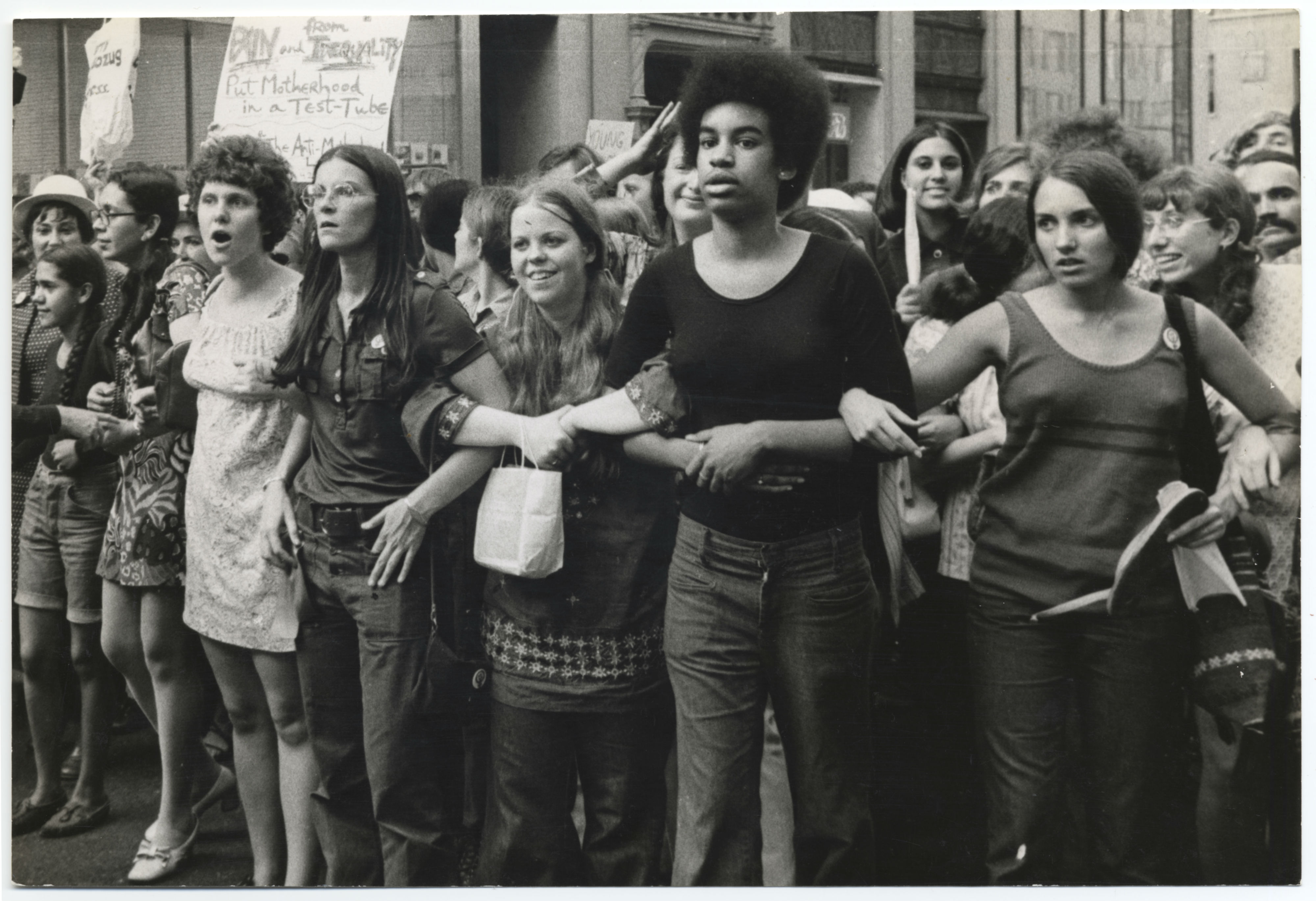
 Though valid points were made using the Radical Feminist approach to pornography, some women felt the elements of desire and domination were not holy negative to women. With this point of contention, the Sex Radical Feminist perspective was formed. Most importantly, the two still long for Women’s Liberation sexually; however, where Radical Feminists believed domination and desire, as portrayed in pornography, sexualized abuse on women as a whole, Sex Radical Feminists believed lived, individual experience determined the negative effects of pornography. Barton states, “Sex radical feminism begins with an exploration of how one’s individual experience does or does not align with a radical feminist critique of social phenomenon” (432). Where Radical Feminists made sweeping generalizations about all women, Sex Radical Feminists allowed for more subjective lived perspectives to shape their understanding of sexuality and Feminism. Furthermore, the Radical Feminist approach neglected to address both the class and race issues surrounding the perceptions of Feminism I discussed in
 So, knowing that both goals are compatible with one another, how can we reconcile the two into a solution? By examining Andrea Dworkin’s “Pornography and Grief” alongside Dorothy Allison’s “Public Silence, Private Terror,” one crucial element became clear to me—Consciousness- raising groups. Unifying women in groups of support rather than excluding them from the discourse allows for unification that needs to occur in order for Women’s Liberation to be successful. Both Dworkin and Allison emphasize the importance of communication in furthering their call to action. Dworkin, at a Take Back the Night event, calls on women to stand up to “the fixedness of the male compulsion to dominate and destroy” (438). She uses her speech to raise awareness on the violence surrounding women’s bodies and pornography, and she implores women to “take back the night every night” (440). To me, a Take Back the Night event is a large consciousness-raising group that aims to change the perspective of domination and women’s bodies. Similarly, Allison calls on women to be more understanding of lived experiences surround sexuality. She writes, “None of us (women) is safe, because we have never made each other safe . . . We have addressed violence and exploitation and heterosexual assumption without establishing first the understanding that for each of us desire is unique and necessary and simply terrifying” (445). By addressing the fear surrounding female existence, Allison, much like Dworkin, is calling on young women to understand one another and to unite for change. For both Allison and Dworkin, the idea of silence as a means of oppression is central to their beliefs surrounding sexuality. By eliminating this silence via consciousness-raising groups, the Radical Feminist and Sex Radical Feminist approaches can begin to eliminate the stigma surrounding sexuality and feminism. Once this silence becomes a roar, discussing sexuality in public discourse will no longer be plagued with awkward pauses but enriched with meaningful insight.
 The manipulation of space has its roots deep in the history of mankind. I know that sounds like an opening that people say “Don’t start with throughout history.” Trust me. I would avoid it if I could, but in this case, it’s true. In his book Discipline and Punishment: The Birth of the Prison, Michael Foucault examines the impact behavior modification can have on a person—namely prisoners. While his belief that augmenting a person’s behavior and limiting their spatial freedom was exceptional useful (depicted as rather sadistic throughout the work), these same fundamental ideas can be seen in Fatima Mernissi’s essays “The Meaning of Spatial Boundaries.”
 Foucault argues the use of imprisonment and punishment manipulate bodies in such a way that true expectation is eliminated and the prisoner is left essentially waiting for orders. As Foucault states, “it is the body of exercise, rather than of speculative physics, a body manipulated by authority, rather than imbued with animal spirits; a body of useful training and not of rational mechanics, but one in which, by virtue of the very fact, a number of requirements and functional constraints are beginning to emerge” (155). Basically, the manipulation of bodies begins to condition the person to live and act according to orders given to them. This renders the body’s natural abilities docile and readily overtook by commands (i.e. the docile body is powerless).
 The ability to manipulate the body and the space of interaction is a key tenet surrounding Muslim expectations of public spaces and power dynamics. Fatima Mernissi describes the accepted behavior between Muslim men and women in public spaces as containing “regulatory mechanisms (that) consist primarily of a strict allocation of space to each sex and an elaborate ritual for resolving contradictions arising from the inevitable intersections of space” (Bordo et al 350). The very idea of a guideline to dictate interaction demonstrate the manipulative restrictions that exist on Muslim female bodies. She continues to depict this limitation as she describes the Muslim perception of public spaces as “male spaces” in which women “trespass” (350). Labeling public spaces as in this way exemplifies the ability of culture to manipulate human bodies, and its ability to set limitations on the mechanical body which allows the natural body to form.

 Since reading Hannah Arendt’ The Human Condition, I truly believe the public/private binary is one of the most overlooked yet important elements of, well, the human condition. In the digital modern world, I think the ability to act in a public sphere of exposure has changed dramatically. I mean, anyone can join a sub-Reddit or Facebook group and contribute to the discourse of that given group all from the safety of their computer. The world has gotten smaller in that respect. However, to me, there is a difference between acting publicly in private and acting publicly in public. This seems particularly challenging for those groups (LGBT, Latinos, etc.) ostracized to the periphery of a culture.
 After reading Norma Morgrovejo’s article “The Latin American Lesbian Movement: Its Shaping and Its Search for Identity,” the struggles of the Lesbian Movement within Feminism outside the Wester/European world became clearer to me. It seems, for Lesbians in Latin America, the journey for agency exists in both a private and public sphere. Morgrovejo summarizes the Latin American Lesbian search for agency as a search “for spaces of legitimization . . . Within the civil society and . . . independently, in order to configure themselves as political subjects capable of generating public discourse” (Bordo, et. al. 312). For Latin American Lesbians, this struggle for agency stems from a strict Catholic state of existence that silences those who choose a homosexual/Non-“Traditional” lifestyle. With such deep cultural influence from Catholicism, Latin American Lesbians are stripped of their identity as women, as validated by the expectations of heteronormativity and family, and are left, essentially, with a clean slate of existence. To generate a new perception of themselves within the Latin American discourse, Lesbians needed to begin their agency development in the private sphere or, as Morgrovejo writes, “behind closed doors” (312).
 With this new beginning, Latin American Lesbians found the Feminist Movement to be an excellent source of inspiration. Morgrovejo describes the revelations experienced by Latin Lesbians under the aegis of feminism as a realm of exposure for which they could “think of themselves in terms of their particularities as women (313). It is important to remember that because of their rejection of heteronormative expectations in Latin American Catholic culture, they had been stripped of this identity. For the Latin American Lesbians, “Feminism provided them with the theoretical and methodological tools to analyze the unequal relations between men and women” (313). This theory, they believed, still operated and contrasted with the male-dominated, heteronormative culture they wished to reject. Essentially, they could not truly identify and develop agency within Feminism because they believed the male-dominated world still determined its existence. Using the theory surrounding Feminism (mostly the power dynamics of the male/female binary), Latin American Lesbians began to use “separatism as a strategy for political organization and positioning that allowed them to elaborate theoretical spaces based on autonomy” (313). They wished to establish a discourse in which male-dominated cultural influences did not permeate the idea of what a woman should be and how she should operate in contemporary culture.
 With a sense of longing, Latin Lesbians delved further into the idea of autonomy for agency development. Their desire for autonomy, as Mogrovejo writes, “Should be understood as a result of their experiences . . . and their resistance to both the heterocentric policies of feminism and the phallocentric and misogynistic practices of the homosexual movement and the left” (315). Because these public spheres left Latin American Lesbians isolated, they called for a rethinking of “lesbian identities” and “to work on the proposals that emerged from experience and the body itself” (315). This concept, conceived out of a need to express themselves public and develop agency within the world, revolutionized the concept of gender and identity. Latin American Lesbians called on contemporary discourses to evaluate the lens with which we see the world. The prescribed expectations placed on genders in both the heteronormative culture and the Feminist Movement oftentimes do not accurately reflect the beliefs of its constituents. In the case of Latin American Lesbians, this spawned a rejection that shifted the focus of gender and sexual identity politics within the region.
 The work of the Latin American Lesbians, explored in Norma Mogrovejo’s “The Latin American Lesbian Movement: Its Shaping and Its Search for Autonomy,” makes clear the importance of consciousness-raising groups within a movement. As we’ve seen with the Latin American Lesbians, this idea of making the private public is not easily done. Of course, in the digital age, this becomes a lot easier, but the very idea of exposing oneself to the public sphere can be suffocating for some people. I see this challenge acted out in my students every day. The isolation that comes from the inability to expose oneself publicly robs that person of any agency within the world. As a staunch believer in self-love leading to world-love, this idea of isolation troubles me, but it also lets me know there is work to be done. How can you accept and love yourself if your identity leaves you on the periphery of the periphery?
 Simone De Beauvoir begins her book The Second Sex by depicting the inherent patriarchal mindset of contemporary discourse by asking a simple question and providing an answer. She writes, “What is a woman . . . The fact that I ask it is in itself significant. A man would never get the notion of writing a book on the peculiar situation of the human male” (Bordo et al. 199). By calling to light the very idea of woman as an Other that needs explained, she is able to illuminate the world to its preconceived notions of gender, power, and ideology that shape the patriarchy as superior. Similarly, Ann M. Ciasullo, in her essay “Strained Sisterhood: Lesbianism, Feminism, and the U.S. Women’s Liberation Movement,” collects three works that accurately depict the idea of compulsory heterosexuality, and its influences in contemporary feminist thought. Ciasullo depicts the divisive, definitive, and damaging entities in an already strained movement and calls on the unification of all women. Where De Beauvoir challenges the notion of woman as a cultural Other, Ciasullo’s collection challenges the idea of heterosexuality as culturally normal and in doing so, allows the reader to understand the importance of transcending and eliminating the binaries of male/female, butch/femme, and hetero/homo in order to further the Woman’s Liberation Movement.
 Answer One: In the Radicalesbians’ “The Woman-Identified Woman,” the ideas of lesbianism and feminism go hand-in-hand. They passionately write, “A lesbian is the rage of all women condensed to the point of explosion. She is the woman who, often beginning at an early age, acts in accordance with her inner compulsion to be a more complete and freer human being than her society . . . cares to allow her” (301). This idea of freedom seems unachievable unless a woman is a lesbian. They believe that lesbianism is not so much a sexual preference but more of a revolt against the heteronormative expectations of women in the contemporary world.
 Answer Two: Another method of deriving a definition of what feminism is came from Amber Hollibaugh and Cherie Maraga. In their essay “What We’re Rolling Around in Bed With: Sexual Silences in Feminism,” Hollibaugh and Maraga hold similar perceptions of lesbianism as a filter dictated by a male-driven society. They negotiate the place of lesbianism in the world based on “a society where heterosexuality is considered the norm” (Bordo et al). This belief seems similar to the notions put forth by the Radicalesbians. Unlike the Radicalesbians, Hollibaugh and Maraga argue that heterosexuality does not necessary mean heterosexist.
 My Answer (As a Heterosexual, White Male): Through both these readings one thing that sticks with me. Much like De Beauvoir’s belief that the concept of woman is inscribed by the world in which we live, Feminism acts in the very same way. For Radicalesbians, it exists within the realm of Lesbianism. For Hollibaugh and Maraga, it is embracing and re-conceptualizing the idea of sexual desire. For both, it seems, feminism performative. Feminism is a performative act in which the things you do and say reflect the ideals of the Feminist movement. For both the Radicalesbians and Hollibaugh and Maraga, feminism is an ideal reflected in how you present yourself to the world. That being said, I believe the concept of feminist thought lies in what you do within the movement by remaining authentic to your true self. If one must compromise their true self, they are often more hesitant to support an idea. Essentially, You can like men or women or both and STILL be a feminist. Furthering the struggle of the Feminist movement while remaining authentic to yourself is not only more inclusive and beneficial for the Feminist movement but also necessary for the cultivating of individual self-love that is imperative to the progress of all movements.
 The idea of critically thinking about your subject position is something that not everyone takes the time to do. By neglecting subject position, people turn a blind eye to prejudices and perceptions that are inherently engrained within their discourse. I am a white, cisgender, heterosexual male from a close-minded and isolating portion of Pennsylvania (At this time, please enjoy the often used logo of my home county). There are elements of this world that, as a child, I perceived as normal simply because of where I was raised. The idea of injustice carried a different and, unfortunately, still carries, a different meaning than it does other places. This is caused by a number of reasons. One: The town and county are 98% white. Two: A majority of the town lives at the poverty line. The working class makes up a majority of the population, therefore, the perception of outside causes not directly correlated to them rarely sees the light of day. There are some who move out of the town, much like myself and, through research and exposure, begin to better recognize social injustices, but even though my current surroundings and stance in the world changed, where I grew up does not. That’s why to truly understand and eliminate social injustices, it is imperative to assess where you’re currently positioned and where you were previously positioned within the world. When you negotiate the past with the present, steps towards the future become more purposeful and impactful to the world around you.

 Tice discusses the feminist movement’s affinity to “neglect to confront the landmines of class privilege, power, and hierarchies within their own organizations and in everyday behavior” (214). This neglect is emphasized by the exploitation and tokenization of the American Myth. Tice describes the American Myth as a depiction of America as “the land of opportunity” (217). To take full advantage of the opportunity, one must “work hard, stay in line, (and) you’ll get ahead. (Getting ahead always means money) (217). In order to solidify this idea, contemporary culture idolizes tokens of this American Dream. Despite its glimpse of hope, tokenization does little to help any movement, but it does aid in pacifying the masses and sedating the resistance struggle within the contemporary world. It “creates a smug security for middle-class whites. It also allows them to be blind to class differences by showing them people who ‘made it.’ The middle-class person then assumes that with extra effort a ‘disadvantaged’ person can get ahead, she just has to work harder” (217). So, basically, the idea of addressing class disparity falls from middle and upper-class shoulders to the working-class people themselves. If the problem is depicted as an individual problem, it is no longer a societal concern and can easily be seen as a non-factor in determining social reform.
 In The Last Straw, Rita Mae Brown stresses the bastardization of the American Myth and its pervasive, oppressive presence within American youth. She writes, “All public school children are fed this myth. It gives poor people hope and it reinforces middle-class people’s belief in their own superiority” (222). Teaching in an urban, impoverished area, I have first-hand experience with the pressure to tell kids they can be anything they want to be when they grow up. In the age of social media, it seems the idolization of exceptions (i.e. tokens) is more popular than it’s ever been. I mean, the internet is flooded with Kylie Jenners and pink-haired rappers that reinforce this idea of the American Myth and the ability of hard work to yield fame and fortune. As a teacher for the last five years, I’ve witnessed the shift from realistic careers to unrealistic ones, and when kids fail, it is often viewed as laziness and lack of self-efficacy. This classist mentality imposed on young children does not take into consideration mass incarceration, immigration, and a panoply of other systemic measures of oppression that they WILL be faced with (those who disagree with the idea of systemic oppression should read The New Jim Crow by Michelle Alexander and Race Matters Race Matters by Cornel West and get back to me on that.) That being said, in most schools, it is still frowned upon to illuminate 13-year-old kids to systemic oppression no matter how impactful it will eventually be. To me, this idea of emphasizing exceptions over realities and neglecting the obvious roadblocks most minorities (race, gender, and/or class) face is incredibly detrimental to young people, but it seems to be the “American Way”
 Ginny Berson discusses the issues with class in Class Revisited: One Step Forward, Two Steps Back. It seems she argues for a unification of classes in order to further the ideas of feminism. She calls for a change to classist thought within the feminist movement and stresses the idea that “women can change—that middle-class women can recognize in themselves patterns of behavior that are oppressive to lower class women, oppressive because they arise out of material privilege; and also that lower class women can recognize in themselves patterns of behavior that result from their oppression” (227). I believe this idea of recognition is imperative to the success of not only the Feminist Movement but also any social movement. By evaluating our subject position and reconciling it with the world around us, we can begin to identify and address the classist nature of contemporary discourse. Once identified, the notions of fear, isolation, and abandonment within any subjugated member/group of any movement becomes more apparent. Much like the theorist discussed in previous blogs, it seems the best way of advancing feminist thought is a collective consciousness that allows for empathy and encouragement. When the divides of any group no longer exist, people begin to naturally unify and strive for a change they can believe in.
 While operating under the white male gaze, African-American women are forced to reconcile both their race and their gender. Hopson describes the torment black women face/d when joining the Women’s Liberation Movement. She writes, “Black women who participated in the movement were labeled “race traitors,” often derided as being lesbians (a fact of sexual identity for some), and regarded as dupes for when feminists, promoting a cause in which they were not even a consideration” (261). On the surface, this idea seems outrageous, but when you take into consideration the oppressive racial bias that dampened the agency development of African-Americans (male and female), the idea of joining “forces” with a movement perceived as white, understandably, seems like heresy to African-American men. However, what African-American women realized well before men is the power structure that exists in both white and African-American men is one of oppression and objectification of women. This realization brought the idea of intersectionality to the forefront of the feminist movement, but unifying all women became a challenge because of the pre-existing nature of racial bias. To aid in the idea of unification, intersectionality, and feminism, Hopson calls on the works of Mary Ann Weathers, Pauli Murray, Michelle Wallace, and Audre Lorde to depict the importance of gender alliance, despite race, and its necessity in improving the Women’s Liberation Movement.
 In An Argument for Black Women’s Liberation as a Revolutionary Force, Mary Ann Weathers emphasizes the idea of a gender unification by calling to light the categories of gender over the categories of race. Of course, the idea of being Othered as female and black is something African-American men cannot comprehend. Therefore, the idea of joining a movement that associates you with white women becomes a means of dissent to African-American men that are struggling for civil liberties. To Weathers, placing race over gender, although often done, is a direct impact of the male gaze and its control over the female body and agency development. She states, “Black women . . . have been expounding all their energies in ‘liberating’ black men (if you yourself are not free, how can you ‘liberate’ someone else?) (270). Weathers is referencing the participation of black women in a man’s world. This “adhering to basic false concepts” is something that limits the ability of women to truly seek liberation because they are still operating under the gaze of male oppression (271). However, in a world dominated by the male gaze, the movement must look to unify all people not specify gender or race because in specifying you isolate. She calls for a “pro-human for all peoples” movement (272).
 Pauli Murray discusses the impact race has had on agency development for African-American women in The Liberation of Black Women. Murray believes, “Black women, historically, have been doubly victimized by the twin immoralities of Jim and Jane Crow. Jane Crow refers to the entire range of assumptions, attitudes, stereotypes, customs, and arrangements that have robbed women of a positive self-concept and prevented them from participating fully in society as equals to men” (273). If someone has never felt truly comfortable in the world because of their gender or skin color, how can African-American women begin to unify with other women of color and white women to evoke a change? For Audre Lorde the answer is LOVE.
 In her article “Eye to Eye: Black Women, Hatred, and Anger,” Audre Lorde emphasizes self-love as the root of unification and liberation for all people. As discussed, African-American women have been made to feel Othered on multiple levels. First, they exist as African-Americans an already oppressed people. Second, they operate under the male gaze. This duplicity makes agency development increasingly difficult and the likelihood of isolation and self-hatred rise. To combat these evils, Lorde calls on African-American women, and all people essentially, to love themselves and in loving themselves, being able to love one another. She beautifully writes, “I have to learn to love myself before I can love you or accept your loving. You have to learn to love yourself before you can accept me or my loving. Know we are worthy of touch before we can reach out for each other” (278). In order for unification to happen and the Women’s Liberation Movement to become all-inclusive, we must focus on self-love and when we love ourselves, we begin to love those around us.
 This idea of self-love is something I first read in Cornel West’s Race Matters. West describes the plight of African-American agency development and really its absence. He called on self-love to enrich the lives of those displaced by systemic racism and oppression. Seeing this idea applied specifically to African-American women, shows its importance to agency development and progress within the Women’s Liberation Movement. By encouraging self-love, humanity is able to extend that love and extinguish the oppressive power structures that limit the agency development of so many people. Self-love leads the way for progress and progress is ultimately the goal for any liberation movement. In order to elevate those oppressed, as Lorde states we must “speak the truth to each other, (and) it will become unavoidable to ourselves” (279). These truths (love, equality, etc.) are imperative to the success of not only the Women’s Liberation Movement but also humanity as a whole.
 This apparatus begins with the male gaze and solidifies by manipulating the narrative that surrounds women and their bodies. Much like De Beauvoir, the theorist Bordo chose to exemplify in this section depict the way women’s body image and expectation are shaped through the male gaze and the detriment these myths have on female agency development within the male-dominated world. While focusing explicitly on the female orgasm, the theorist provided an excellent insight into the perceived roles of women within the contemporary culture. By challenging the sexual myth imposed on women, these theorists, rather than simply acknowledging, are actively engaging and calling for a change to the “misrepresentation, oppression, and invalidation that surround women” (231).
 In her book The Female Eunuch, Germaine Greer challenges the depiction of the female sexual experience. She claims the idea of sex, more specifically the vagina and the desires of women, has been/is kept under a shroud of secrecy and in-turn, has enabled the idea of passivity to pervade the discourse surrounding women and sexuality. One point of Greer’s that struck me was the language surrounding the sex organs or both males and females. She writes, “All the vulgar linguistic emphasis is placed upon the poking element: fucking, screwing, rooting, shagging are all acts performed upon the passive female: the names of the penis are all tool names” (238). The words used by Greer are a limited list. Teaching seventh grade has opened my eyes to an entirely new vernacular surrounding intercourse. Stinging, banging, tapping are all words I’ve heard used to represent the act of sex, but the power of these words and their ability to diminish a woman’s role sexually is beyond comprehension. In depicting sex as an act that happens to a woman (bang, tap, root, etc.), contemporary discourse allows the idea of passivity to infiltrate the minds of women. Sex no longer is shared between two people. Rather it is done to the female by the male.
 With the idea of discourse and its disempowering nature surrounding female sexuality, I found that Luce Irigaray and Audre Lorde’s return-to-self message were incredibly powerful reads. Despite the belief that Irigaray can “make literal-minded readers dizzy,” (234) her message of empowerment is an infallible necessity for enriching the discourse surrounding sexuality. I loved the idea of a self-reliant desire and its ability to challenge the power dynamic that shapes the world. In The Sex Which is Not One, Irigaray states “Female sexuality has always been theorized within masculine parameters . . . the opposition “virile” clitoral/ “feminine” vaginal passivity which Freud—and many others—claims are alternative behaviors or steps in the process of becoming a sexually normal woman, seems prescribed more by the practice of masculine sexuality than by anything else” (248). The idea of passivity is something that is instilled in the minds of not just women but men as well. This contributes to the idea of toxic masculinity that plagues the world in which we currently live. By reinforcing this binary, contemporary culture encourages the idea of not only female passivity but also male insecurity. Males who do not dominate sexually are viewed as “soft” and are often times made to feel inferior. I believe, it is this fear of impotence that drives men to overcompensate in egregious and detrimental ways. By emphasizing the desire and satisfaction within one’s own body, people begin to challenge the binary that limits the world in which we live. When one becomes comfortable in themselves, the need to seek validation in this infectious binary becomes unimportant.
 Similarly, Audre Lorde touches on the idea of the erotic She defines the erotic as “a measure between the beginnings of our sense of self and the chaos of our strongest feelings. It is an internal sense of satisfaction to which, once we have experienced, we know we can aspire” (255). In her work, The Use of the Erotic: The Erotic as Power, Lorde describes the oppressive nature of contemporary discourse and its effect on agency development. She writes, “In order to perpetuate itself, every oppression must corrupt or distort those various sources of power within the culture of the oppressed that can provide energy for change” (255). Of course, in order to maintain superiority, the male gaze must manipulate the way women view themselves and their experiences in the world. Lorde continues, “For women, this has meant a suppression of the erotic as a considered source of power and information within our lives . . . the superficially erotic has been encouraged as a sign of female inferiority; on the other hand, women have been made to suffer and to feel both contemptible and suspect by virtue of its existence” (255). Much like the ideas expressed by Greer and Irigaray, Lorde calls to light the oppressive gaze that limits women’s ability to truly develop agency within the world.
 Simone De Beauvoir’s culture-altering work The Second Sex (1949) has always been a source of inspiration for me both as a person and as an academic. She falls into that particular category of people that state obvious things so eloquently that they seem brand new. Susan Bordo discusses some of these revelatory observations as she introduces De Beauvoir. Bordo states, “Beauvoir argues that within the social world, there are those that occupy the unmarked position of the ‘essential,’ the universal, the human, and those who are defined by their difference from the norm” (194). This statement, to me, becomes the foundation of De Beauvoir’s works. In a world where “essentialism” is a fundamental pillar of the discourse, De Beauvoir asks us to challenge the notions of superiority and inferiority that pervade our perception of the world. In essence, why have white males historically come to embody the essential idea of human life?
 For De Beauvoir, the label woman is something bestowed upon a person upon birth. So where does this label come from and how does it begin to carry with it such oppressive and limiting thing? Clearly, “women experienced their place in the world very differently than men . . . these differences were the result, not of an ‘existential condition’ but of the concrete inequalities, ideology, mythology, and limitations placed on their lives” (195). De Beauvoir rejects “the notions that either biology or eternal feminine essence were women’s natural inheritance” (196). Throughout the excerpts from The Second Sex, the answer to my previous question becomes quite clear. So, how did the idea of woman come to carry with it the limiting attributes that plague women to this day? Simply put: The Male Gaze. (Capitalization used for effect!).

 In her essay “The Mythology of the Doudou: Sexualizing Black Female Bodies, Constructing Culture in the French Caribbean,” Jacqueline Couti explores the negative impacts the European gaze had on gender formation within the Carribean culture, particularly that of the female. Focusing explicitly on the exploitation of the French Caribbean by European “tourists,” she begins by stating the insurmountable reality that women of color face in a European, male-dominated world as one in which they must negotiate “awareness of the gendered self . . . hand-in-hand with awareness of the racial self” (Bordo, Alcalde et al.). Caribbean women were made aware not only of their existence as a woman but also their existence as an African-American as well. This duality is something that reflects in the Caribbean culture of the modern day. Journalist Lafcadio Hearn was one of the earliest journalists to exploit the Caribbean. His novels Youma: The Story of a West Indian Slave and Two Years in the French West Indies (1890) were integral artifacts in the development of Euro-centric, male-dominated concepts within the Caribbean culture. Using works of Hearn, Couti explores the bastardization of Caribbean females and the horrific impact it has on the culture while exploring the scares it still has today.
 As humans are so wont to do, Hearn develops a system of categorization for the women in the West Indies. Once they were categorized by European eyes, Caribbean women became the infatuation of the European male-dominated gaze. It is under this gaze that the labels doudou and da were constructed not using the Creole definition but, in typical European fashion, using their interpretation. Doudou, in mainstream culture, “designates the mesmerizing mulatto woman as the ideal or potential lover who offers her favors to the white man” (132). The use of this term becomes increasingly alarming to me by European colonizers because, as Couti states, the actual Creole interpretation of doudou is “darling” (132). Similarly, the word da became the oppositional binary for the doudou by implying “the asexual dark-skinned maternal figure who takes care of white Creole children” (132). Using these terms as a means of opposition, Hearn develops a binary that expresses both European sexual desire and maternal desire. For Hearn and the Europeans, being of fairer skin meant that the woman was closer to the European ideal skin tone and could become a source of sexual desire while the darker complexion of the da implied their unacceptable skin tone made them suitable to care for the family. Basically, one could be “longed for” sexually while the other could be “used” for housework. By resignifying the term as one that appeases the European male, Hearn basically takes a term of endearment for the Caribbean culture and makes it a term of endearment for the white, European culture. Couti stresses this point when she writes, “The white male defines the black female” (132).

